.png)
Why is my content not performing well in financial markets?
Most of the problems for financial content teams are not just production bottlenecks that lead to publishing too little. More often, the issue is publishing content that is too generic to earn attention in a saturated market.
Organic search traffic for financial services has dropped 7% year on year, and 60% of Google searches now end without a click. It is tempting to blame the search landscape. But the data is more nuanced. Semrush's analysis of over 200,000 keywords found that AI Overviews do not automatically suppress click-through rates, in some cases, they increased them for sites that earned citations. The firms losing ground are not simply victims of algorithmic change. They are publishing content that would have underperformed in any environment.
The real problem is a strategic mismatch: content written for a broad, undefined audience, without the specificity, expertise signals, or structural clarity that financial readers actually reward.
This article sets out what separates high-performing financial content from low-performing content, across five dimensions: audience definition, trust signals, informational value, structure, and distribution. It also provides a practical audit framework for diagnosing where a piece of content is falling short.
What does low-performing financial content look like?
Low-performing financial content is not always bad writing. It is often competent, well-intentioned, and topically relevant. What it lacks is precision. It speaks to the market in general rather than to a specific reader with a specific concern. And in a category where clients are making high-stakes decisions about their money, general is not good enough.
The patterns that characterise underperforming content are consistent across firms of different sizes and strategies.

Search engines and AI platforms increasingly reward experience-driven, authority-backed content, particularly in financial services, which sits in the "Your Money or Your Life" (YMYL) category where Google applies its highest editorial scrutiny. Content that would pass in a lower-stakes vertical often fails in finance simply because the bar is higher.
What high-performing financial content does differently
The contrast with high-performing content is visible in the first part of any piece: a defined reader, a specific concern, and a clear signal that the author has genuine expertise in the subject.
Research on content performance in financial services is consistent on this point: content that addresses the real concerns of a defined audience wins. Broad market updates, by contrast, perform well as relationship tools but have limited impact on organic visibility or AI-driven discovery.
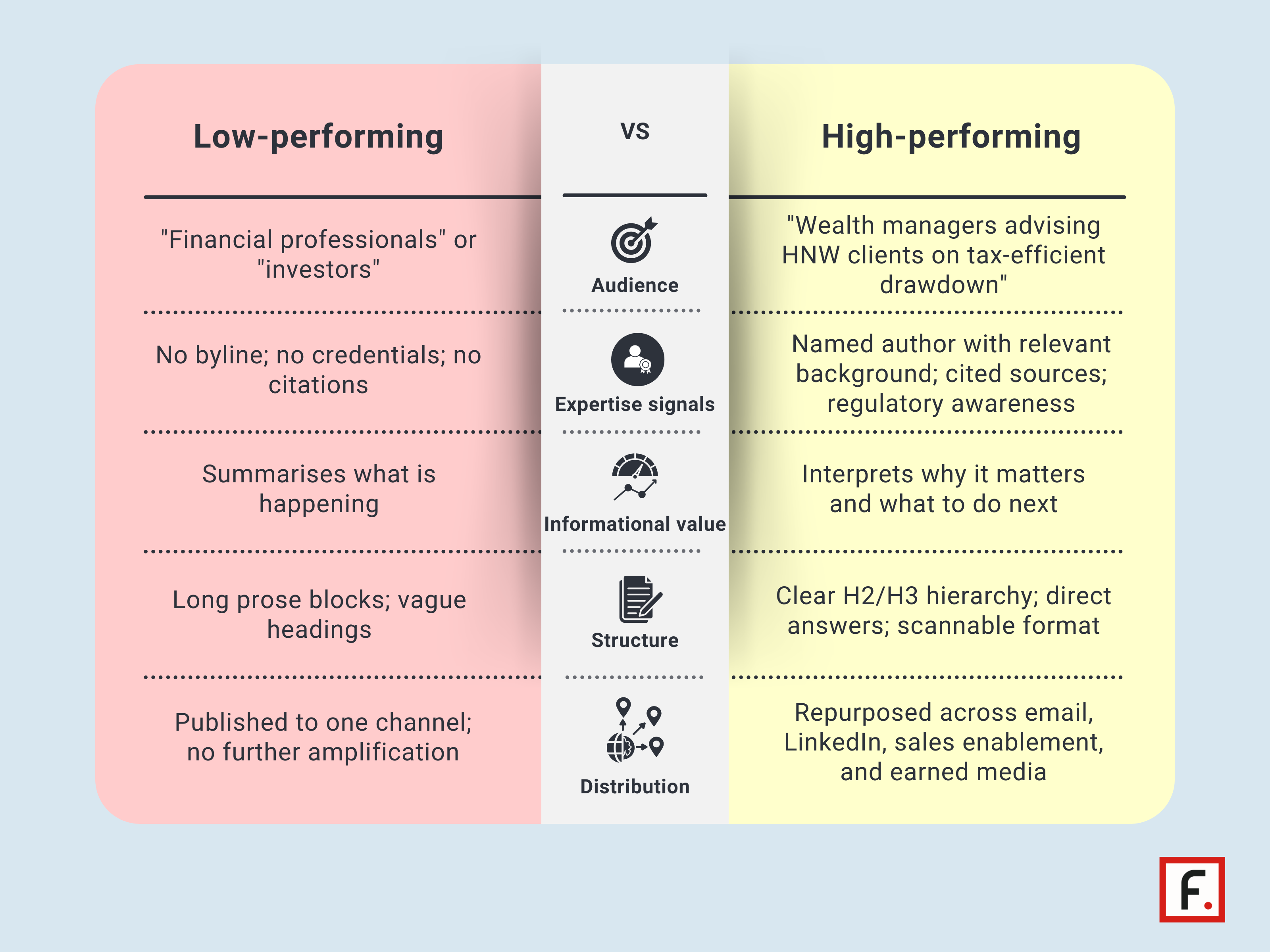
What the winning content actually looks like in practice
High-performing financial content tends to share several characteristics regardless of format:
- It opens with a direct, specific answer to the question the reader arrived with, then extends into interpretation and context.
- It names the author and, where relevant, their qualifications or institutional affiliation.
- It cites external evidence e.g. regulatory guidance, market data, research, rather than asserting claims without support.
- It is structured so that individual sections can stand alone: a reader who extracts one paragraph should still find it useful and credible.
- It is built with distribution in mind. The best-performing financial content is often designed simultaneously as a long-form article, a LinkedIn post, an email newsletter item, and a sales conversation starter.
The implication is, high-performing financial content is not just better written. It is better planned. The audience, the evidence base, the structure, and the distribution channel are all decided before the first sentence is drafted.
The five biggest reasons content underperforms in financial markets
Most underperforming financial content fails for one of five reasons. Often, it fails for several simultaneously. Working through these as a diagnostic framework helps identify where effort should be directed.
1. Weak audience definition
Content written for "the market" or "financial professionals" is not written for anyone in particular. The more specific the intended reader (their role, their concern, their decision context), the more likely the content is to resonate, be shared, and be cited.
Diagnostic question: Could you name the specific person this article is for, and describe the decision they are trying to make?
2. Insufficient trust signals
Financial readers are sophisticated and sceptical. They assess credibility quickly. Content without a named author, without cited sources, and without any acknowledgement of regulatory context signals low editorial rigour, regardless of how accurate the underlying information is.
AI-powered search systems apply the same scrutiny. Platforms like Google and the large language models powering AI-driven discovery are designed to surface content that demonstrates experience, expertise, authoritativeness, and trustworthiness. In finance, the absence of these signals is penalised more heavily than in most other categories.
Diagnostic question: If a reader knew nothing about your firm, would this article give them reason to trust your judgement?
3. Low informational value
There is a significant difference between content that reports and content that interprets. Reporting tells readers what has happened. Interpreting tells them what it means for their specific situation, what the risks are, and what they should consider doing differently. Most underperforming financial content stays at the reporting level.
The firms that build authority through content are the ones that consistently take a position, offering analysis that a reader cannot find by skimming a market data feed.
Diagnostic question: Does this article offer an interpretation or recommendation that is specific enough to be disagreed with?
4. Poor structure and discoverability
In 2024, we’ve already seen bot traffic exceed human-generated traffic, constituting 51% of all web traffic. According to Cloudflare CEO Matthew Prince, in an interview at the SXSW, AI bot traffic will exceed human online traffic by 2027 due to the rapid growth of artificial intelligence.
The content that retains visibility in this environment is content structured so that individual sections can be extracted and cited. That means clear headings, direct answers at the start of each section, and formatting that makes the logical structure of the argument visible at a glance.
Long prose blocks without subheadings, bullet points, or comparison elements are the single most common structural failure in financial content.
Diagnostic question: Is your content structured for AI-powered search? And, could a reader extract one section of this article and find it useful and coherent without reading the rest?
5. Weak distribution and wrong KPIs
Publishing is not distribution. A piece of content that reaches only the firm's existing blog audience is not building authority. High-performing content is amplified: through LinkedIn, through sales teams, through earned media placements, and through structured internal linking that compounds its discoverability over time.
The measurement problem compounds this. Traffic alone is no longer a valid KPI for financial content. The more useful measures are visibility in AI-generated answers, quality of referral traffic, and downstream conversion. These are metrics that reflect whether content is reaching the right people and prompting the right actions.
Diagnostic question: What happens to this article after it is published, and how would you know if it was working?
The search landscape will continue to evolve. Financial content that is specific, credible, and well-distributed will outperform generic content.
If you are reviewing your content strategy and want support turning those insights into assets that work for your audience, let’s talk.